Line Models
In easyspec, we have a total of five line models available for fitting with the MCMC method.
All models are defined in terms of the line flux after continuum subtraction, \(F_{\lambda}\).
Gaussian Model
The Gaussian profile is defined by:
Parameters to fit:
\(A\) - Amplitude
\(\lambda_0\) - Mean wavelength (line center)
\(\mathrm{FWHM}\) - Full width at half maximum, where \(\mathrm{FWHM} = 2\sigma\sqrt{2\ln 2}\)
Lorentzian Model
The Lorentzian profile is defined by:
where \(\gamma = \mathrm{FWHM}/2\) is the half-width at half-maximum.
Parameters to fit:
\(A\) - Amplitude
\(\lambda_0\) - Mean wavelength (line center)
\(\mathrm{FWHM}\) - Full width at half maximum, i.e., \(2\gamma\).
Note: The peak value occurs at \(\lambda = \lambda_0\) where \(F_{\lambda_0} = A\).
Voigt Model
The Voigt profile is a convolution of Gaussian and Lorentzian profiles, defined by:
where the Voigt function \(V\) can be expressed as:
with \(G\) being the Gaussian and \(L\) the Lorentzian component.
Parameters to fit:
\(A\) - Amplitude
\(\lambda_0\) - Mean wavelength (line center)
\(\mathrm{FWHM}_G\) - Gaussian \(\mathrm{FWHM} = 2\sigma\sqrt{2\ln 2}\)
\(\mathrm{FWHM}_L\) - Lorentzian \(\mathrm{FWHM} =2\gamma\)
Skewed Gaussian Model
We start with the classical skewed Gaussian profile, defined by:
Where the parameters are:
\(A\) - Amplitude
\(\lambda_0\) - represents the center of the symmetric Gaussian component but does not correspond exactly to the peak position when skewness is significant.
\(\sigma\) - Standard deviation
\(\alpha\) - Skewness parameter
Note: When \(\alpha = 0\), the profile reduces to a standard Gaussian.
However, we rewrite this classical form of the skewed Gaussian in terms of \(\lambda_{\mathrm{peak}}\), i.e., the position of the line peak in the wavelength axis. We do that by solving for the relationship between the symmetrical-Gaussian line center \(\lambda_0\) and the actual peak position \(\lambda_{\mathrm{peak}}\).
The transformation is achieved through numerical root-finding. For a given skewness parameter \(s = \alpha/\sqrt{2}\) and dimensionless variable \(x = (\lambda_0-\lambda)/\sigma\), we solve the equation:
using Brent’s method. The solution \(x_{\mathrm{peak}}\) gives us the offset between \(\lambda_0\) and \(\lambda_{\mathrm{peak}}\) through:
The final implemented model uses the parameters:
\(\lambda_{\mathrm{peak}}\) - Peak wavelength position (observed maximum)
\(A\) - Amplitude of the Gaussian symmetrical component
\(\mathrm{FWHM}_G\) - The \(\mathrm{FWHM} = 2\sigma\sqrt{2\ln 2}\) of the Gaussian symmetric component
\(\alpha\) - Skewness parameter
This parameterization makes the fitting more physically intuitive, as \(\lambda_{\mathrm{peak}}\) directly corresponds to the observable line peak.
Skewed Lorentzian Model
We start with the classical skewed Lorentzian profile, defined by:
Where the parameters are:
\(A\) - Amplitude
\(\lambda_0\) - represents the center of the symmetric component but does not correspond exactly to the peak position when skewness is significant.
\(\gamma\) - Lorentzian HWHM
\(\eta\) - Skewness parameter
Note: When \(\eta = 0\), the profile reduces to a standard Lorentzian.
However, we rewrite this classical form of the skewed Lorentzian in terms of \(\lambda_{peak}\), i.e., the position of the line peak in the wavelength axis. We do that by solving for the relationship between the symmetrical-Lorentzian line center \(\lambda_0\) and the actual peak position \(\lambda_{\mathrm{peak}}\).
The transformation is achieved through numerical root-finding. If we define \(s = \eta/\sqrt{2}\) and \(x = \frac{\lambda-\lambda_0}{\gamma}\), the line peak occurs at \(\left.\frac{dF_{\lambda}}{dx}\right\vert_{x_{peak}} = 0\), which can be written as:
The solution \(x_{\mathrm{peak}}\) gives us the offset between \(\lambda_0\) and \(\lambda_{\mathrm{peak}}\) through:
The final implemented model uses the parameters:
\(\lambda_{\mathrm{peak}}\) - Peak wavelength position (observable maximum)
\(A\) - Amplitude of the Lorentzian symmetrical component
\(\mathrm{FWHM}_L\) - The \(\mathrm{FWHM} =2\gamma\) of the Lorentzian symmetric component
\(\eta\) - Skewness parameter
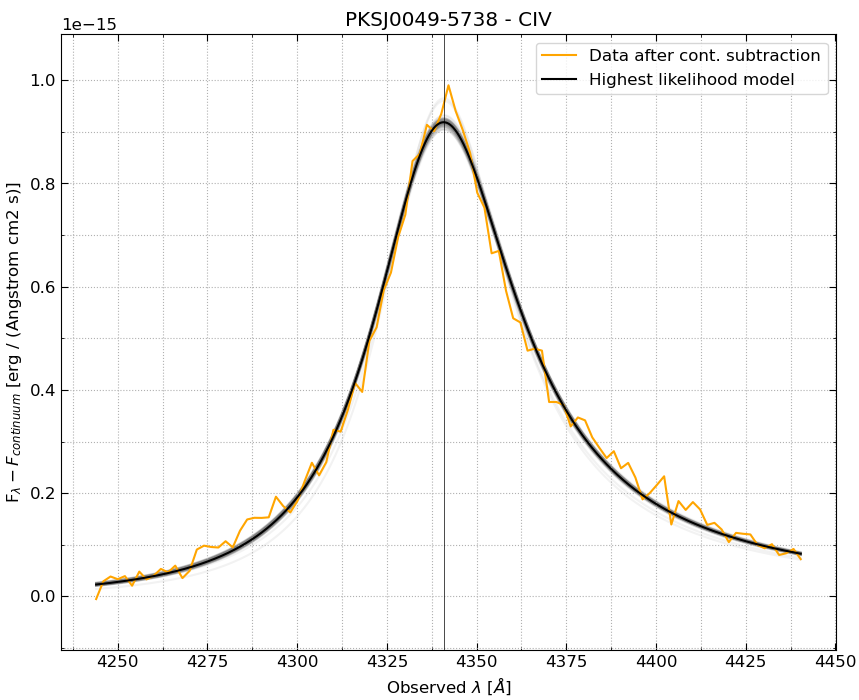
This parameterization makes the fitting more physically intuitive, as \(\lambda_{\mathrm{peak}}\) directly corresponds to the observable line peak. An example of a skewed Lorentzian profile applied to the CIV line of the AGN PKS J0049-5738 is shown below: